FAA Issues GENOT JO 7110.801 Restricting Helicopter Visual Separation
New Restrictions on helicopters in the wake of the DCA Helicopter Accident
After the serious tragedy that took the lives of 67 people over the Potomac River in January 2025, the FAA has been working on ways to improve helicopter safety to avoid future similar incidents. The latest decision, FAA General Note (GENOT) JP 7110.801 revises the guidance given to air traffic controllers on how they can and cannot handle traffic using 'visual separation'.
The GENOT Modifies FAA 7110.65BB, a short 916 page document that outlines many of the procedures and phraseology for air traffic controllers. The relevant section is 7-2-1, "Visual Separation" specifically in the TERMINAL phase (paragraph a).
Visual separation is an often-used measure between ATC and Pilots to 'shortcut' other means of separation, namely radar separation. You're familiar with this procedure if you've ever had an ATC exchange such as:
ATC: "N123AB, do you have the King Air on final in sight?"
Aircraft: "Yes, N123AB has the King Air in sight"
ATC: "N123AB, maintain visual separation with the traffic and pass behind them."
These simple exchanges offer a much easier path than identifying both aircraft on radar, applying radar separation, and keeping aircraft often miles apart. Especially in very busy helicopter areas like DC, New York, or LA, visual separation is often the only thing that makes some kinds of helicopter operations possible.
However, the technique can certainly lead to trouble as well. When Visual Separation becomes the 'norm' it can often lead to pilots accepting responsibility for visual separation when they may not even have the traffic in sight. Pilot's (even subconsciously) learn that they may be subject to lengthy delays if they don't get traffic in sight 'in time' meaning that they may call for visual separation with a 'Get accepted first, find the traffic later' mentality. The DC crash seems to be an unfortunate example of this.
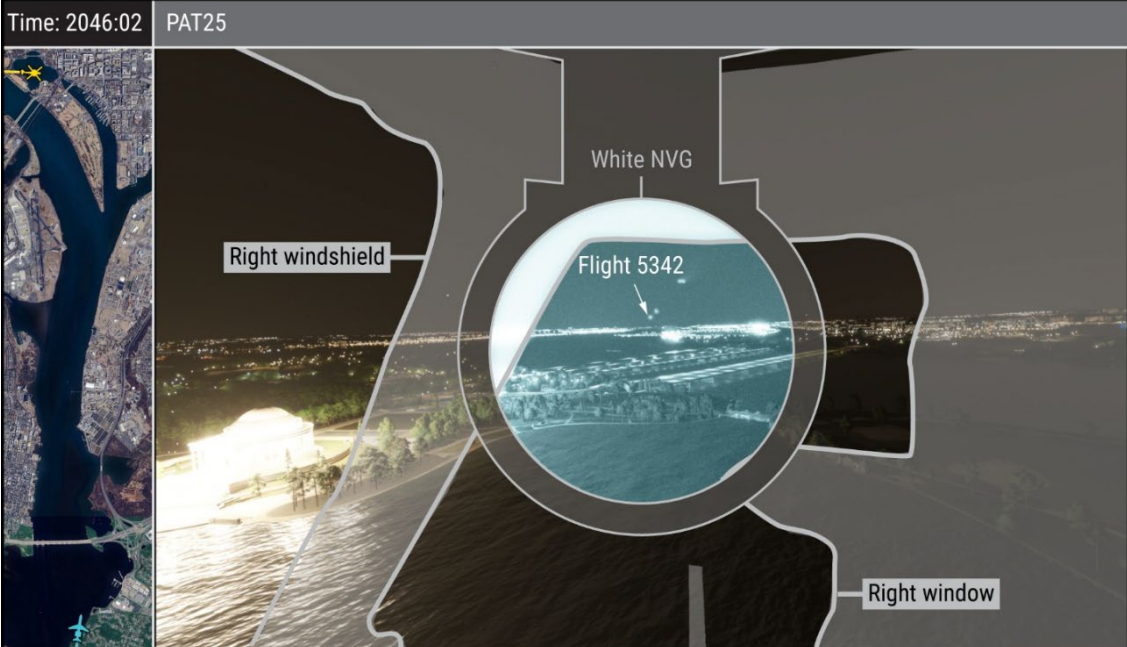
This image is from the NTSB's simulated visibility study of the Potomac crash. It represents the time that ATC first gives a traffic callout to the UH60. Note that the simulation is from the perspective of the right seat, looking out of the right window, and how it displays the extremely narrow field of view that NVGs provide. Crucially, PAT25 reported "traffic in sight, requesting visual separation" after only 6 seconds from the initial callout by ATC. A callout, by the way, that said "Traffic just south of the Wilson Bridge..." That means, that if the instructor truly had the traffic in sight, he took only 6 seconds to mentally process where the Wilson Bridge was, turn his head 90 degrees towards it, and pick out one of many airplane lights on the horizon as the correct traffic target. It is widely theorized that the crew of PAT25 likely ended up mistaking another aircraft for the airplane they would eventually hit.
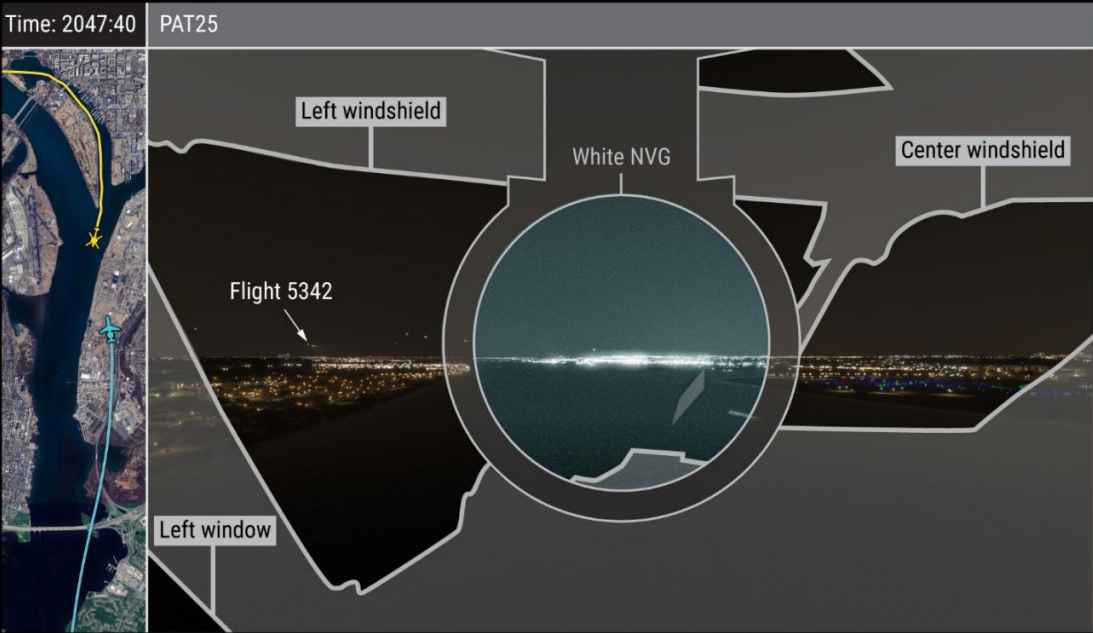
This simulated image comes from just 15 seconds before the collision. Notice how many other background lights are visible, as well as other aircraft.
The environment during the accident over the Potomac was clearly not viable for safe visual separation. Unfortunately, 'close calls' had become such a norm there that it took until only 10-15 seconds before the accident that the controller started questioning PAT25 again whether they truly had the traffic in sight. It's easy to see that visual separation (or the misapplication of it) was certainly a core factor in this accident.
...however...
Does a blanket disapproval of all visual separation between helicopters and landing and departing traffic really seem like a prudent solution?
On the surface, it definitely seems like a logical temporary solution. Which very well may be the case, as the FAA GENOT is scheduled to cancel Dec 24, 2026. Perhaps the FAA is just working on a more permanent solution to the "Visual Separation" problem. Because while cases like the Potomac are textbook cases of visual separation being misapplied, the wording of the new order seems overly restrictive and doesn't always logically make sense.
The GENOT rephrases the paragraph that precludes when any visual separation can be applied to aircraft in a terminal phase, adding "EXCEPT FOR HELICOPTER OR POWERED-LIFT AIRCRAFT CROSSING THE FLIGHT PATH OF ARRIVING OR DEPARTING AIRCRAFT WITHIN CLASS B, CLASS C, OR TRSA AIRSPACE". What this means essentially is that NO visual separation is allowed for Helicopters or powered lift (just helicopters for the rest of this article) with traffic taking off or landing from a Class B, Class C, or TRSA airport. This brings up many pertinent questions:
- Why just helicopters? If anything, helicopters are probably less likely to have issues with visual separation due to generally better visibility, slower speeds, better maneuverability, and lower altitudes. Shouldn't these restrictions just apply to any VFR aircraft?
- Only in Class B, C, TRSA areas could also be interpreted as 'in a terminal environment where a radar is present'. So during takeoff or landing at a Class D airport, a tower may apply visual separation, but at a Class C they aren't allowed to? Sure, maybe this could also have to do with traffic levels, but anyone flying in or out of KLYH, KHEF, KNTU, or any of the hundreds of other busy Class Ds all over the country can tell you that traffic levels there can often exceed those at many Class C airports. Keep in mind as well that the way this is written, this also disallows Tower Applied visual separation, where a controller themselves looks out the window and confirms aircraft are separated.
- Does "Crossing the flight path" involve altitude restrictions too? What if a helicopter were to pass 2,000ft above an aircraft's final approach path?
Other wording brings about some certainly annoying scenarios. For example, "Crossing the flight path...within (airspace)" is broader than you may think. Take a case today, where I was flying inside of the KORF Class C surface area. I was going to pass South of the airport, at the very edge of the surface area of the airspace, while an airliner was landing on Runway 05 (to the Northeast). While both the tower and I could clearly see that I was passing 3-4 miles behind the airliner on short final, because I was "Crossing the flight path of arriving traffic" I had to be instructed to remain East of the centerline until the traffic was on the ground. The only other option would've been to have the controller radar identify me, (usually involving multiple radio calls and changing squawk codes). In this case, it only delayed me 30 seconds, but imagine the same case when, say, a medevac helicopter is trying to cross the multiple approach paths into and out of a busy airport. Radar separation between subsequent aircraft on final is usually at minimums already, meaning that even if the medevac is radar identified, there may not be any radar 'gaps' wide enough to get through. ATC usually relies on visual separation in these cases, but that tool is now gone.
While most pilots can probably agree that the rules surrounding visual separation needed some revision, this seemingly rushed response (1 year after the accident) seems poorly thought out. It invites more questions than answers, and only time will tell what sacrifices will need to be made by ATC and helicopter operators nationwide to keep their operations running smoothly.